


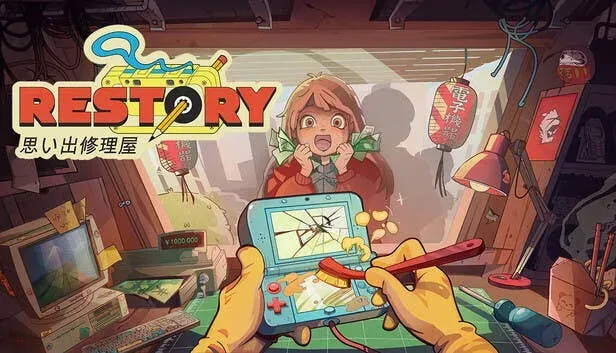
ReStory: First Impressions from the Repair Bench
Some games pull you in with action or story. ReStory: Chill Electronics Repairs pulled me in with a screwdriver.
The premise is simple: you run a small electronics repair shop in mid-2000s Tokyo, restoring old consoles, phones, music players, and other nostalgic devices while chatting with customers about their lives. Having been to Akihabara myself, my interest was piqued immediately. And since I repair old consoles in real life, I had to see how it held up.
From my bench to the game’s (作業台, sagyōdai)
A little background on why this one hit home. I’ve fixed multiple Sega Dreamcasts, done a solder and shell swap on a Pikachu Nintendo 64, and restored a broken Sega CD, which is probably my crown jewel, considering how expensive those have gotten.
Akihabara as a vibe (秋葉原, Akihabara)
The setting is more of a loose backdrop than a full-blown love letter to Akihabara. It sets the table and gives you a vibe, but it isn’t hyper-specific. Think of it as a sprinkling of Japanese influence to keep things fun and cute. The whole game leans into a soft, gentle aesthetic, almost moe (萌え)* in a way.
Simplified, but in the right spirit (修理, shūri)
I’m only on Day 8, so I haven’t unlocked much yet. Among my early jobs, though, were an Atari 2600 and a Sony PSP. Having worked on both, I can say the game is a decent representation of the actual work in a casual, cozy format.
Next on my unlock list is the original PlayStation, and I’m very excited to give that one a go. I’ve worked on a ton of PS1s over the years, including a few mod chip installations so I could play region-free imports. One of those, the Japan-only LSD: Dream Emulator, even got its own video on my YouTube channel, Game & Browse.
Where it simplifies is scale. The main idea of a PSP repair is there, but nothing specific like ribbon cables or springs, and thankfully no soldered components. Cleaning is much easier, too. You start with a brush, canned air is cheap and easy to get, and eventually you can dunk the whole thing in an ultrasonic bath, screens and components included. The game doesn’t penalize you for it. Try that with a real PSP and see how it goes.
Speedrunning a cozy game (スピードラン, supīdoran)
The repair work has been the heart of the game for me. I’ve prioritized buying the best equipment over licenses for more complex projects, which has turned my repairs into quick, snappy jobs.
I love that part. It’s almost a personal challenge to see how fast I can pull a console apart, clean it, and turn it back around. That’s a bit of an oxymoron in a comfort game, but for me, finding that groove and gliding through projects is the comfort.
The customers (お客様, okyakusama)
The customers have been simple so far. The most amusing was an early visitor written as the stereotypical “weeb” otaku. The characters are mostly engaging, but I haven’t pushed far enough to hit any major story beats. I assume it will ramp up more as the stakes become higher.
First impressions (第一印象, daiichi inshō)
Even this early, I’d recommend ReStory to anyone into the cute Japanese aesthetic, and especially to anyone like me who likes tinkering with electronics. The best part is that it’s low risk. Console repair and maintenance can easily go wrong for a novice. Here, the worst that happens is a slower day at the shop. The game doesn’t allow you to fail a repair as far as I know. But you do have bills to pay, so make sure to clear enough revenue to keep the lights on, lest you want to be tinkering in the dark.
I’ll check back once I’ve unlocked more. For now, the bench is calling.
* Moe (萌え): Japanese slang, closely tied to otaku culture, for the warm, affectionate feeling you get toward something adorably cute, usually a character.